

Paid in full, p.1
Paid in Full, page 1


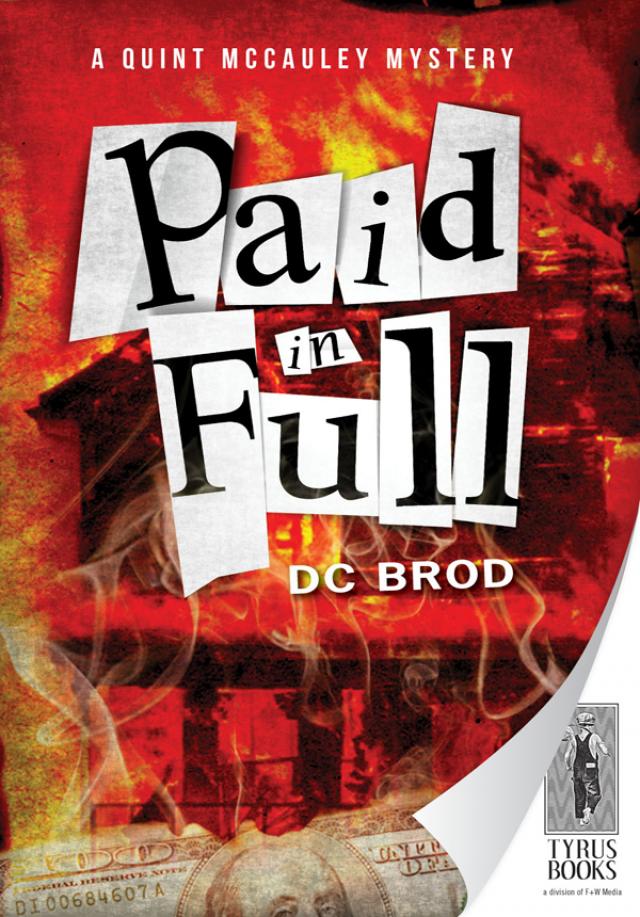
PAID IN FULL
AQuintMcCauley Mystery
D.C. Brod
a division of F+W Media, Inc.
Contents
Cover
Title Page
Chapter 1
Chapter 2
Chapter 3
Chapter 4
Chapter 5
Chapter 6
Chapter 7
Chapter 8
Chapter 9
Chapter 10
Chapter 11
Chapter 12
Chapter 13
Chapter 14
Chapter 15
Chapter 16
Chapter 17
Chapter 18
Chapter 19
Chapter 20
Chapter 21
Chapter 22
Chapter 23
Chapter 24
Chapter 25
Chapter 26
Chapter 26
Chapter 28
Getting Sassy
Also Available
Copyright
PAID IN FULL
Chapter 1
Why do the moments in your life that you’d most like to forget revisit you like past-due notices on your soul, while reminders of the really good ones seem scarce as refund checks?
I pitched in the minors for a few years until my shoulder went south and my ERA north. My first year in class A, I pitched a no-hitter. I was on fire—throwing better than I knew I could. My fast ball left batters shaking their heads as they tossed their bats and retreated to their dugout. In the twenty-some years since that game, not once has a new acquaintance said, “Hey, weren’t you the guy …”
A year and a half ago, I had an ill-advised assignation. Well, almost. Since then I’ve lost track of the number of times it has tainted what otherwise might have been an evenly-matched encounter. It was about to come back at me again like a runaway train.
A year-and-a-half ago Ellie Carver and I shared a brief, albeit intense history. I was new to Foxport, a far west suburb of Chicago, living out of a motel on the east edge of town that was next door to a small tavern with the dubious name of the Dive Inn. A squat, brown prefab building with painted-on windows trimmed in Christmas lights, it used to be what the locals referred to as a “gentlemen’s club” until a women’s group bought space in the paper and started publishing the license plates of cars parked on the lot. Patronage dropped off fast. Now, posters of Olympic swimmers and divers plastered the walls and customers called it a water sports bar. From the outside, the bar looked like it drew a tough crowd; in reality, the Dive Inn and most of its clientele were too tired to be tough.
I had been sitting at the bar nursing my third Scotch, feeling sorry for myself. A number of things had driven me from Chicago, not the least of which included losing my job and my girlfriend at almost the same time. While it was not a high point in my life, I knew I just had to put some days behind me. A couple drinks helped. Sometimes the magic number was three.
I wasn’t aware of anyone in my vicinity until a husky, feminine voice beside me murmured, “Can I bum a cigarette?”
I turned and saw a small, pretty woman with large, liquid blue eyes sitting on the stool next to mine. She wore her blond hair piled up on her head in a haphazard style with a few tendrils falling down over her forehead and ears.
I said sure and pushed my pack toward her. She made a face and muttered something about preferring menthol but took one anyway, then waited for me to light it. As she shot the stream of smoke up at the ceiling, I saw something in the way she looked—the hair, pale pink lipstick, blue eye shadow—that took me back to my senior year in high school where I wasn’t even in the running for most likely to succeed, but all things were still possible. Sitting on the hard bar stool, that appealed to me mightily. I offered to buy her a drink.
She nodded like she expected no less and said, “Vodka gimlet.” I wasn’t surprised.
We talked about things, none of which I recall, and after another drink there didn’t seem to be any question that she’d go back to the motel with me. The bartender, a heavy-set guy with a craggy face and serious bags under his eyes, had been giving me wary looks as I talked to this woman. I figured he had a thing for her, and since she didn’t seem to notice, I refused to let it bother me.
In the yellow light of the motel room, I saw she was older than I’d thought—at least my age which, on an optimistic day, hovers around the midpoint of my life. I wondered what the light did for me. Her kiss was cool and tasted like lime. She pushed away from me and walked over to the bed, pulling her blouse out of her short, black skirt. Standing there with her eyes closed and her chin lifted, she seemed to be trying to superimpose a more compelling image over this one. I couldn’t blame her.
She sat on the bed and kicked off one high heel with the toe of the other while unbuttoning her blouse. It was high-necked with white lace. We’d used up all our conversation in the bar and neither of us bothered with the pretense. We just wanted to get our clothes off.
That never happened. Someone pounded on the door so hard the room shook, as a loud voice announced, “Police. Open up.” I tried to figure out what I’d done to get busted. My companion’s reaction was curious. At first her eyes widened, but then the corners of her mouth twitched—a gesture which, in the short time I’d known her, I’d come to recognize as a preface to a smile. She left her top three buttons undone, crossed one leg over the other and planted her hands beside her, palms down, on the bed. Then she waited for me to open the door.
When I did, two men burst into the room like they were spearheading a major drug bust. Neither was in uniform but they both had the moves. The larger of the two shoved my face against the wall and patted me down. Satisfied I wasn’t carrying, he flipped me around, grabbed my collar and thrust the barrel of a .357 under my chin. I couldn’t swallow.
The cop had a ruddy complexion and narrow, close-set eyes that were a muddy shade of brown. Apparently he’d tried to mask the smell of gin with mint, but it wasn’t working.
“The lady is off limits,” he said. “You got that?” I nodded.
“What’s your name?”
I hesitated, then decided I didn’t want him groping around for my wallet. “McCauley. Quint McCauley.”
“Well, McCauley, if you’re ever seen with this woman again, you’re getting more than a warning.”
Now was not the time to ask her name.
The other cop watched her, keeping his distance as she collected her purse and sweater. She didn’t seem scared or even alarmed. Maybe a little annoyed. Before she left, she stopped and gave me this sad little smile and said, “I’m sorry.”
Had I known she was married to the chief of police, I might have left town in the morning. But, ignorance works in strange ways. By the time I learned Ellie Carver’s name, I had decided to stay in Foxport for a while.
In the eighteen months since then, I had opened a detective agency, gone into partnership in a small import shop with my landlady, Louise Orwell, and moved into an apartment above her house on the Fox River with a border collie I’d adopted. My life wasn’t perfect, but I didn’t need three Scotches at night anymore. Ed and Ellie Carver had separated. No surprise there. The woman who’d left me in Chicago, Elaine Kluszewski, had come back into my life and we had tried again, but failed. Fortunately, the parts that had nothing to do with passion were still intact and we managed to remain good friends. Elaine was now living with Ed Carver. Irony is no stranger to my life.
Which brings me back to the present. I was sitting in my office wondering why one of my clients, a local-hero-turned-investment-wizard, hadn’t bothered to pay me. It had been three months—time to mobilize the collections department. I hated making these calls, but I hated getting them even more. Then the phone rang. Giddy with relief, I lifted the receiver.
“Hi, Quint.” The voice rendered me speechless.
“Quint?”
“Ellie. How’s it going?” I managed.
“Not bad. Not good, but not bad. I need to talk to you. Actually, I think I need to hire you.”
“What for?” I lit a cigarette.
“I’d rather talk in person. Can you meet me at the Dive Inn? You remember where that is, don’t you?” I thought I detected a smile in her voice. “Seven-thirty?”
I hesitated. “Why me?”
She sighed. “I went through my whole list of people, and you’re the only one who might be able to help me who I think I can trust.” Then she added, “Kind of sad, isn’t it?”
I didn’t think that was an intentional slam.
“Will you be there?” she asked.
“Sure,” I finally said. “Seven-thirty.”
Three seconds after I hung up, the phone rang again. I should have known better than to answer. Bizarre occurrences tend to enter my life in pairs. But I’m nothing if not a slow learner. This time it was Elaine.
“I have a big favor to ask.” Elaine didn’t believe in couching her requests. I admired that about her. Usually.
“I’m listening.”
“I’d rather ask in person. You know, so I can tell what you really think.”
“Don’t worry. I’ll tell you what I really think.”
“All right.”
Silence. “I’m listening.”
“Well, I don’t know if you’re aware of this, but,” she drew in a deep breath, “Ed is allergic to cats.”
It took me all of three-quarters of a second to figure out where this was heading. “Elaine—”
“Let me finish.” She kicked her deliver
“I think so. You’re fostering out your cat on the presumption that your relationship with Ed Carver isn’t going to be permanent.”
“I’m not sure that ‘presumption’ is the right word, but I’ll give it to you.”
“Does Ed know this?” If he didn’t, I wanted to be the one to tell him.
“He doesn’t need to know.” She paused. “Besides, McGee is a neat cat. It would be easy to find a home for him. Even you admit he’s okay.”
“As cats go.” I guess I’m too lacking in self-love to want an animal who is going to spend the day sleeping, eating and ignoring me. I need a pet that is something of a sycophant. Peanuts, my border collie, fits the bill nicely.
“Look, I don’t want to make light of this commitment you and Ed have, but do you know how long it’s going to take to decide whether it’s working?”
“Never mind. Forget I asked.” From the way she clipped off her words, I knew my attitude annoyed her, but evidently not enough to hang up.
She had me cornered. If I said no, she’d have to give up either McGee or Ed. If she gave up the cat, she’d be hurt. If she gave up Ed, my motives would appear sus- pect. I really believed she deserved better than Ed Carver. But then, I also thought she deserved better than me.
I rode out the silence for another ten or fifteen seconds, and then I sighed. Real deep so she’d hear. “We’ll see how it works. Peanuts isn’t used to sharing me, you know.”
“That’s okay. McGee ignores you anyway.”
“I know.”
“Don’t take it personally, Quint.”
“I’ll try not to.”
“I really, really appreciate this.”
“I know.”
“When can I drop him off?”
“Why don’t I come by your place? I’ve got a few errands to run anyway.”
“You sure?”
“Yeah. Is two okay?”
“Great.”
I hung up and ground the cigarette into the brown plastic ash try, adding its crumpled white carcass to the half dozen others. The window air conditioner droned behind me. Absently, I hoped it lasted the summer.
Why didn’t I just let her bring the cat to me? I finally admitted that I wanted to see how Elaine filled the spaces in Ed’s apartment. I also wondered what he was doing these days since losing his job as Foxport’s chief of police. He’d been ousted in the spring thanks to some political finagling. Once the smoke cleared and reason returned to everyone involved, they’d offered him his job back. He said no. I had to admire his resolve, which, in the face of survival is pretty scarce these days. I just hoped he didn’t hang up his shingle and become my competition. Foxport wasn’t big enough for both of us.
The detecting business was down. If it weren’t for the income from the Jaded Fox, I’d be in bad shape. It was just too damned hot to get riled up about anything enough to hire a detective. Spouses who suspected their mates of cheating on them were either grateful for the respite or had taken to the idea themselves. More likely the latter. Libidos tend to run high during August heat waves.
I lit another cigarette, noting how lousy it tasted, muzzled my dignity and punched in the delinquent stockbroker’s number.
Chapter 2
I slammed the phone down. Hell, on a good day Kurt Wicklow made ten times what he owed me. If the guy could afford to take the day off, he could afford to pay me twenty-five hundred bucks. When I’d asked his assistant where I could reach him, she informed me that she couldn’t give out that information. I could tell by the way she said “I’m sorry,” sort of wallowing in it before she moved on, that she wasn’t.
Time for a tactical adjustment. I don’t usually bother clients at home. But there was no reason to be discreet about the work I’d done for him. I’d left three messages at his office and he hadn’t bothered to return any of them. Maybe he’d respond to an attack on his castle.
I pulled his record and noted his address put him among the big, expensive homes surrounding Foxport’s country club: 39W265 Tammi Hill. As I punched in the phone number I figured the residents should count their blessings. The developer could have had a kid named Benny.
A woman answered on the third ring and in response to my request to speak to Wicklow, told me he was out of town.
“When is he due back?”
“Any time. Today perhaps. Tomorrow.” From the sound of it, Wicklow wasn’t on a tight schedule. “This is Gina Wicklow. Can I give him a message?”
He probably ignored the messages he got at home faster then the ones he got at the office. In spite of the odds, I went ahead and gave her my name and phone number.
After a brief pause during which I assumed she was writing this down, she said, “Will he know why you’re calling?”
“He should.” Then, I added, “He owes me twenty-five hundred dollars for some work I did for him.”
“He does?” She sounded both surprised and confused. “I-I’m sorry.”
The little stutter deflated me. “It’s probably a misunderstanding,” I offered. “Would you make sure he calls me?”
“Of course, I will. I’m sorry you had to call.”
I mumbled something about that being all right and hung up, secure in the assumption that Wicklow wouldn’t respond to this message either. His wife sounded sincere enough, but I didn’t think Wicklow took her seriously. He had once referred to her as a “professional hobbyist.”
I glanced at my watch. Just after eleven. Since it was early for lunch and I felt ornery, I decided a stop at Wicklow’s office might prove interesting. His assistant, Karen Lassiter, didn’t care much for me. It hadn’t always been that way. She’d been real friendly and helpful when Wicklow first hired me, and she even invited me to join her and some friends at her parents’ cabin in Wisconsin for the weekend. I declined. Being trapped for forty-eight hours with a bunch of strangers sounded like a bad idea. (I learned later that she liked to lure unsuspecting pagans such as me up to the cabin where she and her church friends tried to show us the light.) After that, the pit bull aspect of her personality blossomed. From the hoops I had to jump through just to talk to Wicklow, you’d have thought I was the IRS trying to audit his records instead of a guy hired to save him from a lawsuit.
Karen and I jousted, we parried, we slung thinly veiled insults at each other, and when I nailed the guy trying to sue Wicklow, it must have ripped her in two. I kind of enjoyed the game, though I’m not sure Karen did. It had occurred to me that Wicklow might not be the one sitting on my check.
Like many of Foxport’s businesses, Wicklow’s office was in a refurbished home. It had probably housed a fairly well-to-do family when it had been built back in the twenties. If it fit the typical scenario, after going through several owners, it became a rental property, eventually falling into disrepair until Foxport’s rebirth in the seventies. Then a savvy investor snatched it up and sank some money into it, restoring it to its former stateliness. A wooden sign hanging from a lantern-topped post listed the occupants. On it, Kurt Wicklow, Investment Counselor, separated a lawyer from an aromatherapist. I love this town.
I parked on the street behind Karen’s red Cavalier and walked up the curved, stone path to the building. That was when I noticed a man on one of the top rungs of a ladder, painting the detail in the eaves. He wore cutoffs and a sleeveless T-shirt and his shoulders had turned a bright red in the scorching sun. The house was a pale shade of blue and most of the accent trim a darker blue. Using a small brush, he added gray- brown strokes to the scrollwork. As I watched, he pulled a white rag out of his back pocket and wiped off a few inches, dipped the brush in another pint-sized container and painted over the smudge. I couldn’t see any difference in the color, but that kind of attention to detail was typical of property owners around here.
Just standing there watching him made me sweat harder. I climbed the steps, anticipating the air-conditioned cool.
Karen looked up from her desk as I opened the office door. When she saw me, her mouth twisted into an annoyed frown. “I should’ve known you’d find your way here.”






